Cavalier King Charles Spaniel Price in Australia 2026 — what you'll actually pay
By Dogthings Editorial · Updated 2026-11-04
Affiliate disclosure: Some links on this page earn us a commission at no extra cost to you. We only recommend products and services we'd use with our own dogs.
The Cavalier is one of the gentlest small dogs there is, and the parent breed behind the cavoodle. In 2026, a Cavalier King Charles Spaniel from a reputable Australian breederranges $3,000–$6,000 (median around $4,500). That's the headline — but the price of the puppy is usually the smallest cheque you'll write for this breed. Small breed economics work in your favour — lower food cost, smaller dosing for parasite prevention, cheaper desexing. The flipside is dental work, which hits small breeds harder than any other line item.
What actually drives the Cavalier King Charles Spaniel price
The $3,000–$6,000 range looks wide because it is. A Cavalier King Charles Spaniel bought near the bottom of the range is most likely a pet-quality puppy from a smaller breeder with shorter wait-lists, or an interstate pickup where buyers haven't bid the price up. At the top end you're paying for established kennels with multi-generation health testing, in-demand colour variants, or a Sydney/Melbourne metro premium.
Three sliders move the price within the range:
- Breeder reputation: ANKC-registered breeders charge $1,500–$4,000 more than backyard sellers but deliver health-tested parents, contractual guarantees, and lifetime support. For a Cavalier King Charles Spaniel prone to mitral valve disease, that premium pays for itself the first time a claim happens.
- Where you live: Sydney and Melbourne consistently command the highest prices for Cavalier King Charles Spaniels — local demand outstrips local supply, and interstate transport adds $400–$900.
- Pedigree: Show-line or proven working-line Cavalier King Charles Spaniels sit at the top of the range. Pet-quality dogs (perfectly healthy, just not show-standard) sit at the bottom and are the better choice for most owners.
Why a Cavalier King Charles Spaniel costs what it does
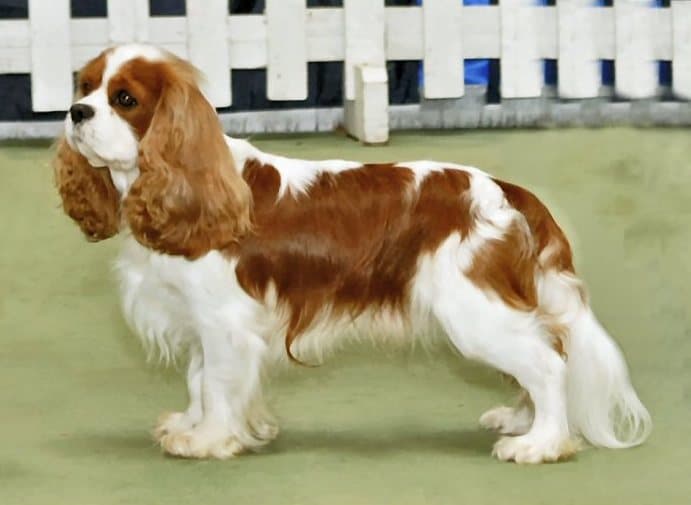
Cavaliers are expensive because careful breeding is expensive. Responsible breeders heart-screen parents every year and only breed from dogs whose hearts stay clear past a certain age, which retires many dogs from breeding early. Demand from cavoodle breeders adds pressure on supply. The four colours (Blenheim, tricolour, black and tan, ruby) are all standard; any 'rare colour' premium is marketing.
What a Cavalier King Charles Spaniel breeder's price should include
Before you pay a deposit, ask to see these results in writing. A breeder charging the top of the $3,000–$6,000 range who can't show them is charging for the name, not the dog.
- Annual heart check for both parents, ideally by a cardiologist, with no murmur at breeding age
- Episodic Falling and Curly Coat / Dry Eye DNA results
- Ask whether the parents have had MRI screening for syringomyelia
- Patella and eye checks for both parents, plus Dogs Australia papers
Red flags: No heart certificates for the parents, very young parents (under about 2.5 years), and sellers offering several breeds or 'cavalier crosses' alongside.
Costs that come with the Cavalier King Charles Spaniel
| Cost | Typical AU price | Why it matters |
|---|---|---|
| Heart disease medication | $80–$200 a month | Lifelong once mitral valve disease needs treatment. |
| Echocardiograms | $500–$900 each | Usually yearly once a murmur is heard. |
| Syringomyelia diagnosis (MRI) | $2,000–$3,500 | If neck scratching or pain signs appear. |
| Grooming and ear care | $60–$100 every 6–8 weeks | Feathered ears and feet matt without it. |
Cheaper ways to get a Cavalier King Charles Spaniel
Retired breeding Cavaliers are often rehomed by breeders, and Cavalier rescue groups place adults. Ask for heart records before you adopt.
Hidden costs every Cavalier King Charles Spaniel owner gets caught by
Beyond the puppy fee, three areas reliably catch new Cavalier King Charles Spaniel owners off-guard:
- Mitral valve disease. Cardiac echos cost $500–$900 each. Lifetime cardiology cases run $1,500–$3,000/year once heart failure starts — and these dogs almost always need it.
- Syringomyelia / Chiari-like malformation. Specialist work-up and treatment for this condition typically runs $800–$3,000 over the dog's life, with insurance covering 70–80% once excess is met.
- Episodic falling. Specialist work-up and treatment for this condition typically runs $800–$3,000 over the dog's life, with insurance covering 70–80% once excess is met.
Year-one budget for a Cavalier King Charles Spaniel
Here's what a realistic first 12 months with a Cavalier King Charles Spaniel looks like, sourced from current AU breeder, vet, and insurer quotes:
| Line item | Lower | Upper |
|---|---|---|
| Puppy purchase | $3,000 | $6,000 |
| C5 vaccinations + first vet checks | $250 | $450 |
| Desexing (small-breed pricing) | $250 | $500 |
| Microchip + council registration | $70 | $230 |
| Food (12 months) | $480 | $840 |
| Bedding, crate, leads, toys | $400 | $800 |
| Puppy school + obedience | $200 | $500 |
| Pet insurance (year 1) | $580 | $1,200 |
| First-year total | $5,260 | $10,520 |
Cavalier King Charles Spaniel lifetime cost (12 years)
Over an average Cavalier King Charles Spaniel lifespan of 12 years, total cost of ownership lands between $24,000 and $49,000. The lower number assumes value-brand food, self-insurance (you bank what you'd pay in premiums and accept catastrophic-cost risk), and a healthy dog. The upper number assumes premium subscription food, comprehensive insurance with a low excess, and one or two major-claim events you wouldn't have absorbed without cover.
For most owners the realistic midpoint is around $36,500. Where you sit inside that range is largely controlled by two decisions: insurance choice and food choice.
Best pet insurance for a Cavalier King Charles Spaniel in Australia
Moderate-to-high premiums for a small dog. Mitral valve disease (MVD) is the defining Cavalier claim: most Cavaliers develop a heart murmur as they age, and medication plus monitoring runs for life. Insure before any murmur is recorded.
There's no single best insurer for every Cavalier King Charles Spaniel; the best policy is the one that covers this breed's expensive conditions without fine-print exclusions. Check these before you buy:
- Breed conditions are covered, not excluded. Read the PDS for exclusions or sub-limits on mitral valve disease, syringomyelia / chiari-like malformation, episodic falling.
- Hereditary and congenital conditions are included, not just accidents and new illness.
- The annual limit covers a big claim. A single surgery can cost aim for $15,000–$20,000+ a year.
- Waiting periods — accidents are usually 0–2 days, illness about 14–30 days, and some conditions (such as cruciate) up to 6 months.
- Insure before the first vet note. Anything recorded before cover starts is excluded for life.
The single most-leveraged decision is whether to insure at puppy stage versus after a first vet event. Pre-existing exclusions are permanent under every AU policy — once your Cavalier King Charles Spaniel has a mitral valve disease on the vet record, no insurer will cover it later. A $50/month puppy-stage policy that locks cover in before any condition is diagnosed is dramatically more valuable than a $90/month senior-onboarded policy with exclusions stacked on.
Knose lets you dial excess from $0 (max cover, higher premium) to $500 (catastrophic-only, lowest premium). Two minutes online.
Food picks for a Cavalier King Charles Spaniel — and what they actually cost
The Cavalier King Charles Spaniel's silky, medium length, moderate shed coat and moderate-energy metabolism shape the food bracket that works best. Editor picks for this breed:
- Royal Canin Cavalier King Charles Adult
- Advance Small Breed Adult
- Hill's Science Diet Small Paws
A small breed eating ~157g/day of premium dry costs roughly $40 – $70/month at retail. Pet Circle's autoship discount (5–10% off + free shipping over $49) takes that to the lower end of the range. Subscription brands like Petzyo sit at the upper end but bundle delivery + cancel-anytime convenience.
Where Cavalier King Charles Spaniel owners actually save money
- Insure early. A 12-week-old Cavalier King Charles Spaniel insured before any vet event locks lifetime cover with no exclusions on mitral valve disease. Waiting until "after the first emergency" guarantees that emergency becomes a permanent pre-existing exclusion.
- Buy parasite prevention from a pharmacy, not the retail vet. VetSupply and chemist retailers stock NexGard, Bravecto, Simparica at 30–50% below clinic prices. For a small dog that's $80–$240/year saved with zero quality compromise.
- Skip routine-care add-ons. Most insurers' routine care modules barely pay back the premium you put in. Bank the equivalent monthly into a dedicated vet fund instead.
- Use council registration discounts. Desexed dogs get 50–70% off council fees in every state. See your state's fee schedule.
- Stay on top of dental. A $600 prophylactic dental clean at age 5 prevents a $1,400 extraction-heavy dental at age 8. Small breeds reward owners who budget for proactive dentals.
Cavalier King Charles Spaniel cost questions, answered
How much is a Cavalier King Charles Spaniel puppy in Australia in 2026?
$3,000 – $6,000 from a reputable breeder. Lower-end pricing usually reflects pet-quality (not show-quality) lineage, smaller regional breeders, or interstate transport flexibility.
What does a Cavalier King Charles Spaniel eat each month?
$40 – $70 on a quality dry food. Fresh feeding roughly doubles that. Picks we trust for the Cavalier King Charles Spaniel: Royal Canin Cavalier King Charles Adult; Advance Small Breed Adult.
Is a Cavalier King Charles Spaniel expensive to insure?
Moderate-to-high premiums for a small dog. Mitral valve disease (MVD) is the defining Cavalier claim: most Cavaliers develop a heart murmur as they age, and medication plus monitoring runs for life. Insure before any murmur is recorded.
How much is a Cavalier King Charles Spaniel in Australia?
From a registered breeder, typically $3,000–$6,000 in 2026. The top of the range usually means heart-checked parents and DNA testing.
Why are Cavaliers so expensive?
Good breeders only breed from heart-clear dogs, screen them every year and often retire them early, so supply is limited. Cavoodle demand also takes many Cavaliers out of purebred breeding.
Is pet insurance worth it for a Cavalier?
Usually, yes — but only if you insure before any heart murmur is recorded. After that, heart disease will be excluded as pre-existing.